
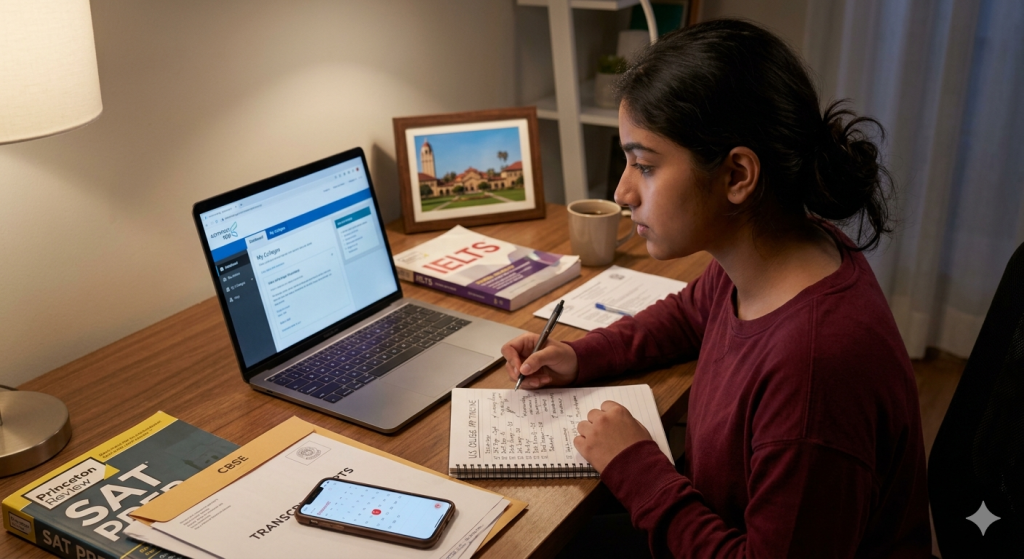
U.S. University Application Process
Posted on : 14 April, 2026 4:13 pm
A Step-by-Step Guide
Applying to U.S. colleges is a transformative journey that opens doors to world-class education at institutions like Stanford, Harvard, or UCLA. For Indian students, navigating this process can feel complex due to differences in academic systems and cultural expectations. With over 1.1 million international students enrolled in the U.S. in 2023, per the IIE Open Doors report, the opportunity is immense but requires careful planning. This guide provides a detailed, step-by-step roadmap to the U.S. college application process, covering the timeline, Common App, Coalition App, essays, recommendation letters, and deadlines, with specific insights for Indian applicants, such as CBSE transcript submission.
Why the U.S. College Application Process Matters
The U.S. college application process is unique, emphasizing holistic evaluation. Unlike India’s exam-centric admissions, U.S. universities assess academic performance, extracurricular activities, essays, and personal qualities. For Indian students, understanding this system is key to standing out among global applicants. The process typically spans 12–18 months, starting in Class 11 or 12 for Indian students aiming for undergraduate programs.
Step 1: Research and Shortlist Colleges (12–18 Months Before)
Begin by exploring U.S. colleges to align with your academic and career goals. Consider factors like program strength, campus culture, location, and cost. For example, MIT excels in engineering, while liberal arts colleges like Amherst emphasize broad-based education. Indian students should research scholarship options, as tuition ranges from $20,000 to $60,000 annually.
- Tip for Indian Students: Use resources like College Board’s BigFuture or university websites to compare schools. Shortlist 8–12 colleges, balancing “reach” (e.g., Ivy League), “match,” and “safety” schools based on your grades and test scores.
- Timeline: Start in Class 11 (June–December).
Step 2: Prepare for Standardized Tests (12–15 Months Before)
Most U.S. colleges require standardized tests, though many are test-optional now. Indian students typically take the SAT or ACT for undergraduate admissions, and TOEFL or IELTS for English proficiency.
- SAT/ACT: The SAT (scored out of 1600) or ACT (36) tests math and critical reading + writing. Top schools like Harvard often expect SAT scores above 1450 or ACT scores above 32. Register via College Board or ACT websites, available in India’s test centers (e.g., Delhi, Mumbai).
- TOEFL/IELTS: Non-native speakers need TOEFL (80–110) or IELTS (6.5–7.5). Book early, as slots fill up quickly.
- Tip for Indian Students: CBSE students often excel in math but may need practice for verbal sections. Prep with free resources like Khan Academy (SAT) or paid coaching in India.
- Timeline: Take tests by June–October of Class 12.
Step 3: Understand Application Platforms (9–12 Months Before)
Most U.S. colleges use the Common App or Coalition App, centralized platforms streamlining applications. Some schools, like MIT or Georgetown, have standalone applications.
- Common App: Accepts over 1,500 colleges, allowing one main essay (650 words) and supplemental essays per school (100–500 words). It includes sections for personal info, activities, and transcripts.
- Coalition App: Used by over 150 schools, it’s similar but emphasizes access for underrepresented students. Some colleges accept both.
- Tip for Indian Students: Create accounts on both platforms in August of Class 12. Familiarize yourself with sections like the Activities List, which may feel unfamiliar due to India’s academic focus. CBSE students should request schools to upload transcripts directly, as self-submission is rare in the U.S.
- Timeline: August–September, Class 12.
Step 4: Craft Compelling Essays (6–9 Months Before)
Essays are a cornerstone of U.S. applications, showcasing your personality, values, and goals. The Common App requires one main essay from several prompts (e.g., reflecting on a challenge). Supplemental essays tailor your application to each college, addressing “Why us?” or specific program interests.
- How to Write Essays: Start with brainstorming personal stories. For example, a CBSE student might write about balancing board exams with a passion for robotics, highlighting resilience. Draft multiple versions, focusing on authenticity and clarity. Keep word counts tight (e.g. 650, main essay).
- Tip for Indian Students: Avoid overused topics like “poverty in India” or generic and stereotypical). Instead, highlight unique experiences, such as a cultural tradition (e.g., organizing a school Diwali event) or leadership in India’s startup ecosystem. Seek feedback from English teachers or mentors, as U.S. style values specificity.
- Timeline: Draft by September–October; finalize by November, Class 12.
Step 5: Secure Strong Recommendation Letters (6–9 Months Before))
U.S. colleges typically require 2–3 recommendation letters from teachers or counselors who know you well. These should highlight your academic abilities, character, and potential.
- Choosing Recommenders: Select teachers from Class 11–12, ideally in subjects related to your major (e.g., Math for engineering). A counselor letter provides context about your school.
- Tip for Indian Students: CBSE schools may lack formal recommendation processes. Request letters early (by September), providing teachers with a resume or list of achievements (e.g., science fair wins, MUN awards). Guide them to submit via Common App or directly to colleges.
- Step 6: Prepare Academic Transcripts (6 Months Before)
Transcripts document your academic performance. For Indian students, colleges require Class 9–12 transcripts, including CBSE board exam results if available.
- Process: Contact your school to prepare official transcripts, translated into English if needed. Some colleges require evaluation by agencies like WES (World Education Services).
- Tip for Indian Students: CBSE mark sheets must be attested by school authorities. If applying mid-year, submit predicted Class 12 grades. Ensure consistency between CBSE grading (e.g., percentages) and U.S. GPA scales (4.0), often explained by your counselor.
- Timeline: Finalize by November–December, Class 12.
Step 7: Complete Financial Aid and Scholarship Applications (6 Months Before)
International students, including Indians, can access merit-based scholarships or limited need-based aid. Tuition costs $20,000–$60,000 annually, making financial planning crucial.
- Options: Apply for university scholarships (e.g., NYU’s merit awards) or external programs like the Tata Scholarship for Cornell. Need-based aid, like Harvard’s, requires CSS Profile or ISFAA forms.
- Tip for Indian Students: Submit financial documents (e.g., parent income statements, bank records) early. Highlight academic or extracurricular excellence to boost scholarship chances, as aid for internationals is competitive.
- Timeline: November–January, Class 12.
Step 8: Submit Applications (3–6 Months Before)
U.S. colleges offer Early Decision (ED), Early Action (EA), or Regular Decision (RD) deadlines. ED is binding (you must attend if accepted), while EA and RD are non-binding.
- Deadlines: ED/EA: November 1–15; RD: January 1–15. Check each college’s website, as dates vary.
- Tip for Indian Students: Apply to 8–12 schools to balance selectivity. Double-check CBSE transcript uploads and test score submissions (via College Board for SAT). Pay application fees ($50–$90 per school) or request waivers if eligible.
- Timeline: Submit by November (ED/EA) or January (RD).
Step 9: Prepare for Visa and Post-Acceptance Steps (After Acceptance)
Once accepted, Indian students need an F-1 visa. Colleges issue Form I-20, required for the visa application.
- Visa Process: Complete the DS-160 form, pay the $350 SEVIS fee, and schedule an interview at a U.S. Embassy (e.g., Mumbai, Delhi). Provide financial proof and intent to return to India.
- Tip for Indian Students: Apply for visas early (April–June) to avoid delays. Attend university orientation programs for international students to ease the transition.
- Timeline: March–June, post-acceptance.
Key Differences for Indian Applicants
Indian students face unique considerations:
- CBSE Transcripts: U.S. colleges may unfamiliar with CBSE’s percentage system. Counselors should explain grading rigor (e.g., 90%+ is equivalent to a 4.0 GPA).
- Extracurriculars: Indian students often focus on academics, but U.S. colleges value activities like debate, sports, or volunteering. Highlight leadership (e.g., school captain) in the Common App.
- Cultural Nuances: Essays should reflect personal growth, not just academic success. Avoid generic narratives and emphasize individual impact.
- Financial Barriers: Limited aid for internationals requires early scholarship research. Indian banks offer education loans, but plan repayment carefully.
Overcoming Common Challenges
Indian students may face hurdles like tight deadlines, high costs, or unfamiliar essay styles. To succeed:
- Start Early: Begin in Class 11 to manage tests, essays, and applications.
- Seek Guidance: Use school counselors, alumni networks, or online forums for advice.
- Stay Organized: Track deadlines with a spreadsheet to avoid missing submissions.
- Practice Essays: Take online writing courses to adapt to U.S.-style storytelling.
Your Path to U.S. Colleges
The U.S. college application process is rigorous but rewarding, offering Indian students access to transformative education. By following this step-by-step guide—researching colleges, acing tests, crafting essays, and securing visas—you can navigate the journey with confidence. Start planning today to unlock your dream of studying in the USA.